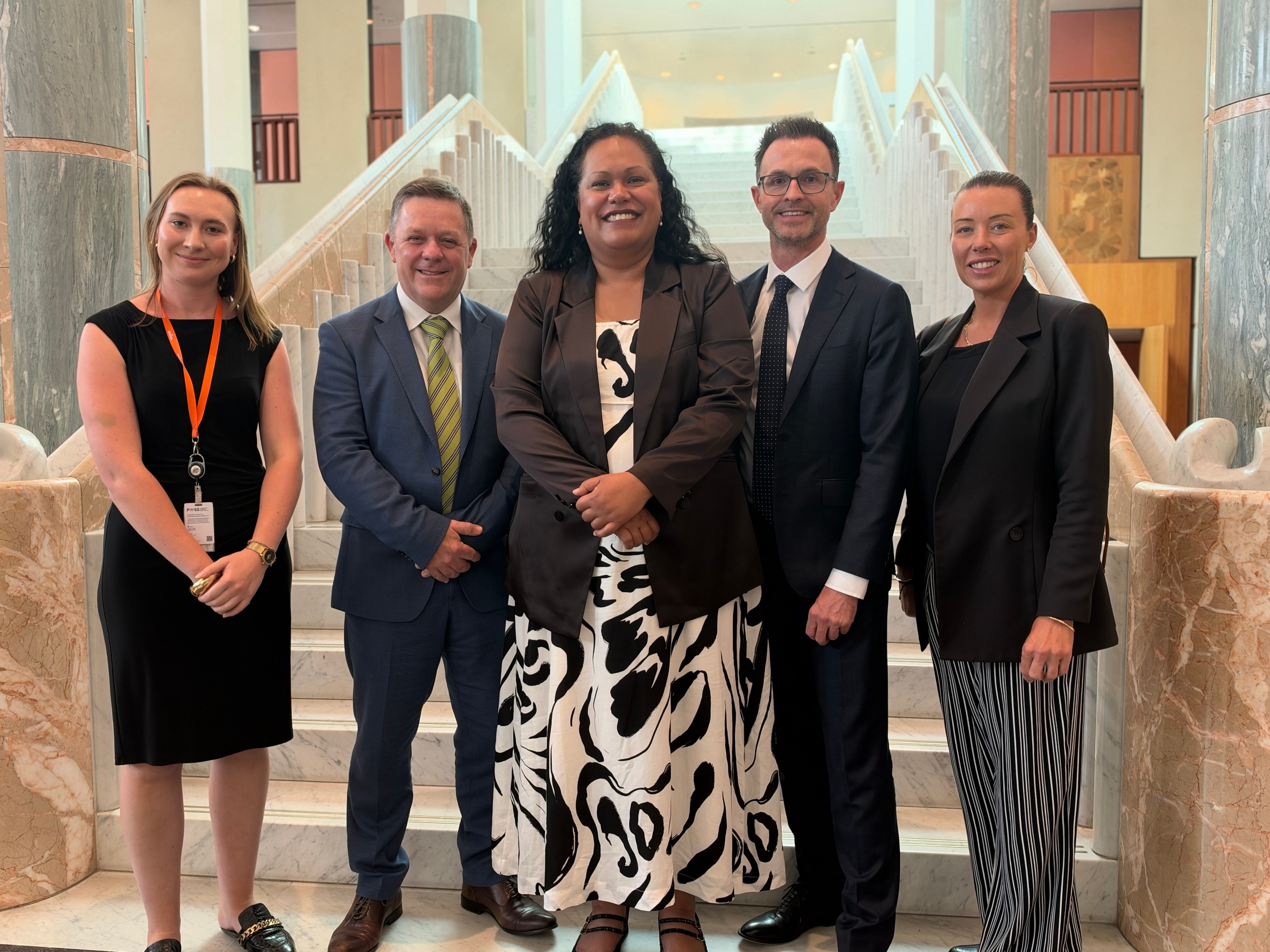

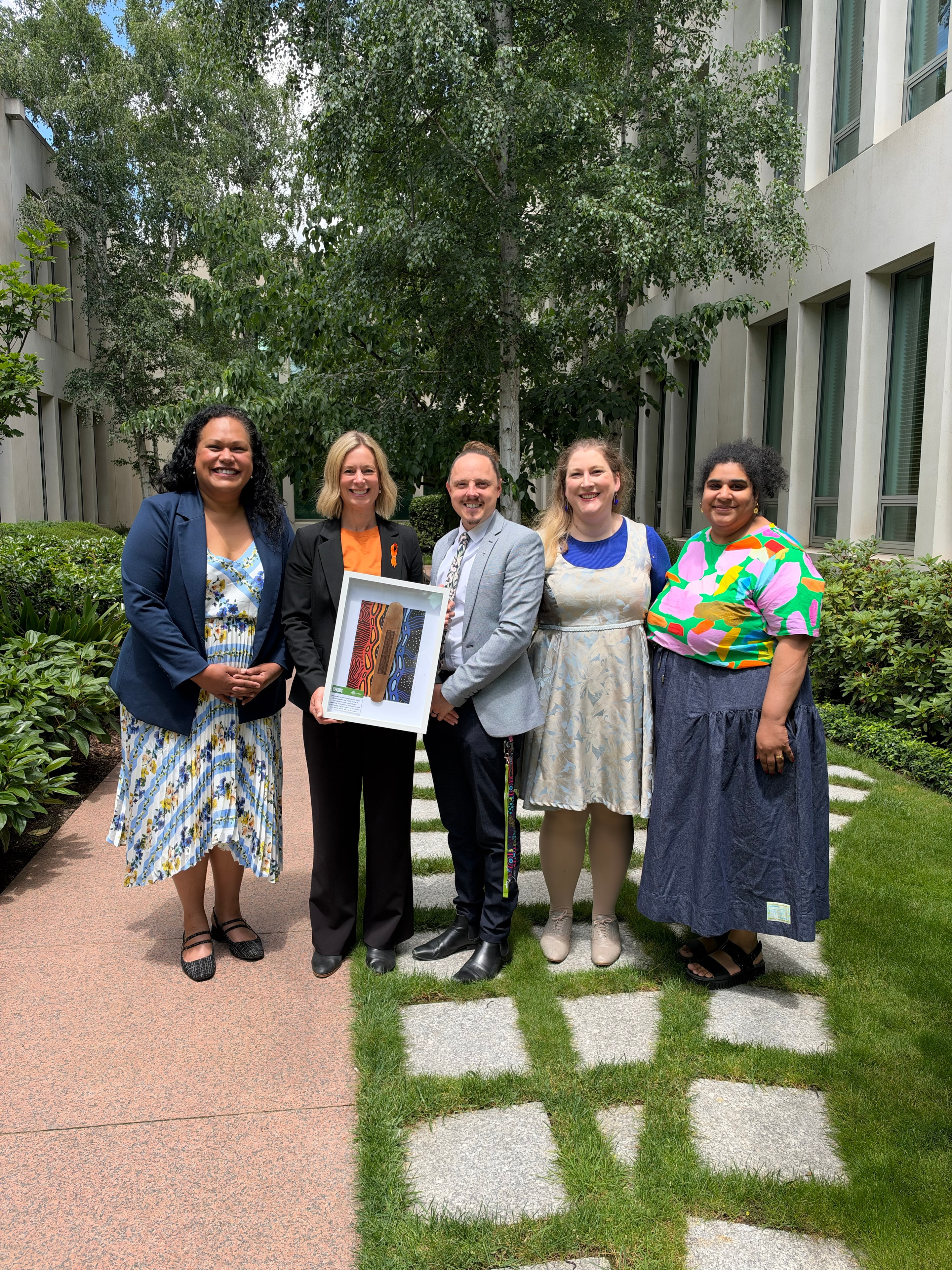
First Nations Eye Health Alliance (FNEHA) Chief Executive Officer Lose Fonua presented the Hon Rebecca White MP, Assistant Minister for Health and Aged Care, Assistant Minister for Indigenous Health and Assistant Minister for Women, with an award recognising the Australian Government’s contribution to eliminating trachoma as a public health problem. Representatives from the Department of Health, Disability and Ageing joined the presentation in Canberra.
The presentation followed celebrations at the 2026 National Aboriginal and Torres Strait Islander Eye Health Conference (NATSIEHC26) in Naarm (Melbourne). On 29 April 2026, the World Health Organization validated Australia’s elimination of trachoma as a public health problem. This significant achievement reflects decades of Aboriginal and Torres Strait Islander community leadership, alongside the collective efforts of community-controlled health organisations, local health workers, governments and eye health partners.
During the meeting, Lose emphasised the importance of protecting this achievement through sustained investment in community-led prevention, health promotion, surveillance and culturally safe care. Maintaining elimination requires a coordinated, long-term approach that strengthens local capacity, addresses the underlying social and environmental determinants of health, and ensures communities are supported to sustain improvements for future generations.
Sustaining Australia’s trachoma elimination achievement requires continued, coordinated investment across health, education, housing and environmental health to create the conditions that support healthy practices and prevent the resurgence of trachoma. Central to this is strengthening community-controlled approaches that embed prevention within everyday community life, supported by accessible infrastructure and responsive health systems.
As part of these discussions, FNEHA highlighted the need for sustainable funding for the ‘Clean Faces, Strong Eyes’ health promotion resources, currently being transitioned from Minum Barreng, the Indigenous Eye Health Unit at the University of Melbourne, to community control through the National Aboriginal Community Controlled Health Organisation (NACCHO). This transition represents an important opportunity to strengthen Aboriginal and Torres Strait Islander leadership in trachoma prevention and must be supported by ongoing government investment.
FNEHA also discussed its broader 2027–28 Commonwealth Budget priorities with Assistant Minister White, reinforcing the need for sustainable foundation funding and a formal Commonwealth partnership with FNEHA, funding for the first four years of implementation of the National Aboriginal and Torres Strait Islander Eye Health Plan 2027–2037, and free prescription glasses for Aboriginal and Torres Strait Islander children.
Together, these priorities reflect FNEHA’s commitment to advancing long-term systems reform, strengthening community control and ensuring that Australia’s progress in Aboriginal and Torres Strait Islander eye health is sustained and built upon for generations to come.
Further reading
- First Nations Eye Health Alliance. Historic Public Health Win Celebrated at NATSIEHC26.
- First Nations Eye Health Alliance. 2026 National Aboriginal and Torres Strait Islander Eye Health Conference archive and report.
- World Health Organization. Australia becomes the 30th country to eliminate trachoma as a public health problem.
- Australian Government Department of Health, Disability and Ageing. Addressing trachoma.
- The Kirby Institute, UNSW Sydney. Australian Trachoma Surveillance Report 2024.
- Minum Barreng: Indigenous Eye Health Unit, University of Melbourne. Trachoma Health Promotion Transition Update.
- First Nations Eye Health Alliance. Eye health pledge must now be backed by funding and First Nations leadership.